Tuesday, February 24, 2015

Keystone State Park: Lake

Around the U.S.

Keystone Lake offers boating, fishing, and swimming, and in the winter, even ice skating. The lake was constructed around 1909 by the Keystone Coal and Coke Company. They used the water in a coal washing facility about two miles away. It wasn't until 1945 that the lake was transferred to the Pennsylvania Bureau of State Parks, and since then, it has provided recreational benefits to all of its visitors.
Keystone Lake 

Only a few cattails were still standing in this patch near the shore of the lake.
Keystone Cattail

Monday, February 23, 2015

Keystone State Park: Mountain

Around the U.S.

Keystone State Park covers 1,200 acres of southwestern Pennsylvania, including 8 miles of hiking trails and a 78-acre lake. I was surprised by how steep some of the trails are. By the time I reached the top of the first mountain, I was ready to stop and watch the sun setting through the trees.
Keystone Sunset

Near the hiking trail ran this set of power lines. It was amazing how the trees had been cleared to form a pathway that was followed by the power lines up one side of a mountain and down the other.
Wires

Sunday, February 22, 2015

Laurelville Mennonite Church Center

Around the U.S.

Southwestern Pennsylvania abounds with hilly terrain, shady forests, and winding streams. On a trip to this area of Pennsylvania, I visited one place that has all of these, along with good hiking trails: Laurelville Mennonite Church Center. There were already leaves budding out on the forest plants, despite the recent sprinkling of snow.
Laurelville

Sunday, February 1, 2015

Creation Museum: Christmas Lights

Around the U.S.

 My evening at the Creation Museum ended with another tour of the gardens, this time with a sea of bright Christmas lights shining in the darkness. It seemed like every tree was a shimmering pillar of illumination, amplified and reflected by the still water of the lake.
Glistening Foliage

Colors ranging from pink to green to gold decorated trees, walkways, and bridges around the elaborate maze of gardens.
Glowing Trees
 
Doubling the brilliance of the decorations was the placid lake, which mirrored all lights in its range. The purple spiral below is on one side of the lake, while the reflected lights are across it.
Reflected Brilliance

Thursday, January 29, 2015

Creation Museum: Petting Zoo

Around the U.S.

In addition to the lake and gardens, the Creation Museum features a petting zoo that houses many friendly animals. One of the most spectacular species was this peacock. When the sun caught its feathers, it looked like a glowing rainbow of multicolored gold.
Peacock

Nearby stood this white llama. With its friendly face and plush fur, it looks like a docile teddy bear. However, visitors who find themselves in the pen may soon find out that llamas are known to kick when upset.
White Llama

Another furry creature was this young kangaroo. It spent its time hopping around and basking in the sunshine.
Kangaroo

Finally, another pen contained a small herd of sheep and goats. Goats have a tendency to escape from any enclosure in which they are housed, and the goat below looks like it is trying to do so. Maybe the no climbing sign should have been on the other side of the fence.
White Goat

Wednesday, January 28, 2015

Creation Museum: Gardens

Around the U.S.

Surrounding the lake was a scenic garden featuring plants from all parts of the world. Equally impressive was the large variety of bridges. The one in this picture is a simple wooden arch bridge with low, arched railings.
 Arched Bridge

In contrast, the bridge pictured below uses the more common straight design. However, its interesting use of light posts as part of the railing makes it unusual.
Lighted Bridge

Tuesday, January 27, 2015

Creation Museum: Lake

Around the U.S.

The landscaping outside the Creation Museum is just as impressive as the interior exhibits. A two-acre lake just outside the museum provides a home for fish and allows visitors who fall off the overhead zip line to land with a splash.
 Reflection 

Another feature of the lake, this picturesque bridge, bears a striking resemblance to a bridge in Monet's famous flower garden.
 Monet's Bridge

This suspension bridge was one of the more popular spots in the garden for wildly jumping up and down. The rocking motion also simulated a storm at sea.
Rocking Bridge

Sunday, July 27, 2014

Creation Museum: Dinosaur Den

Around the U.S.

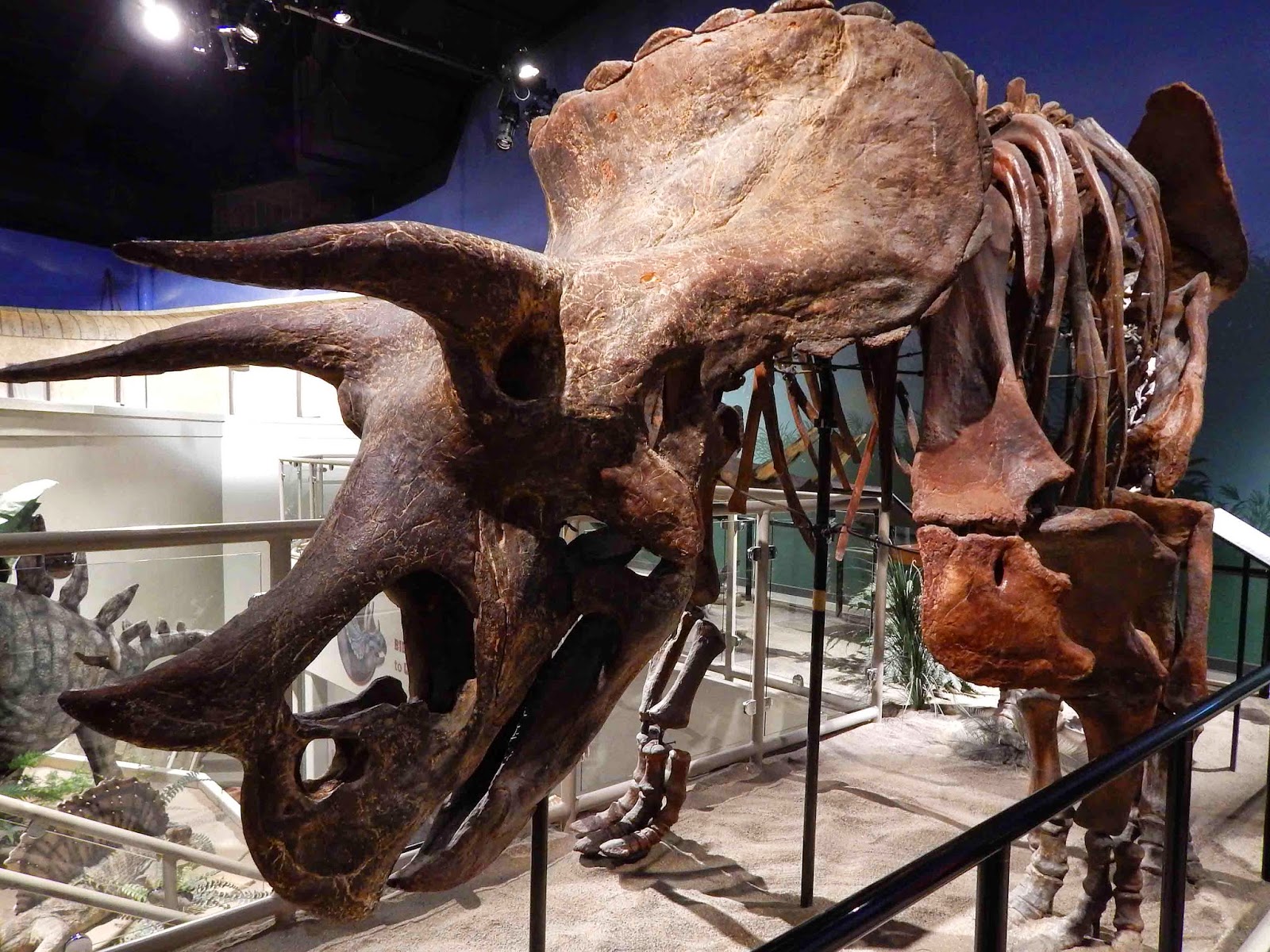
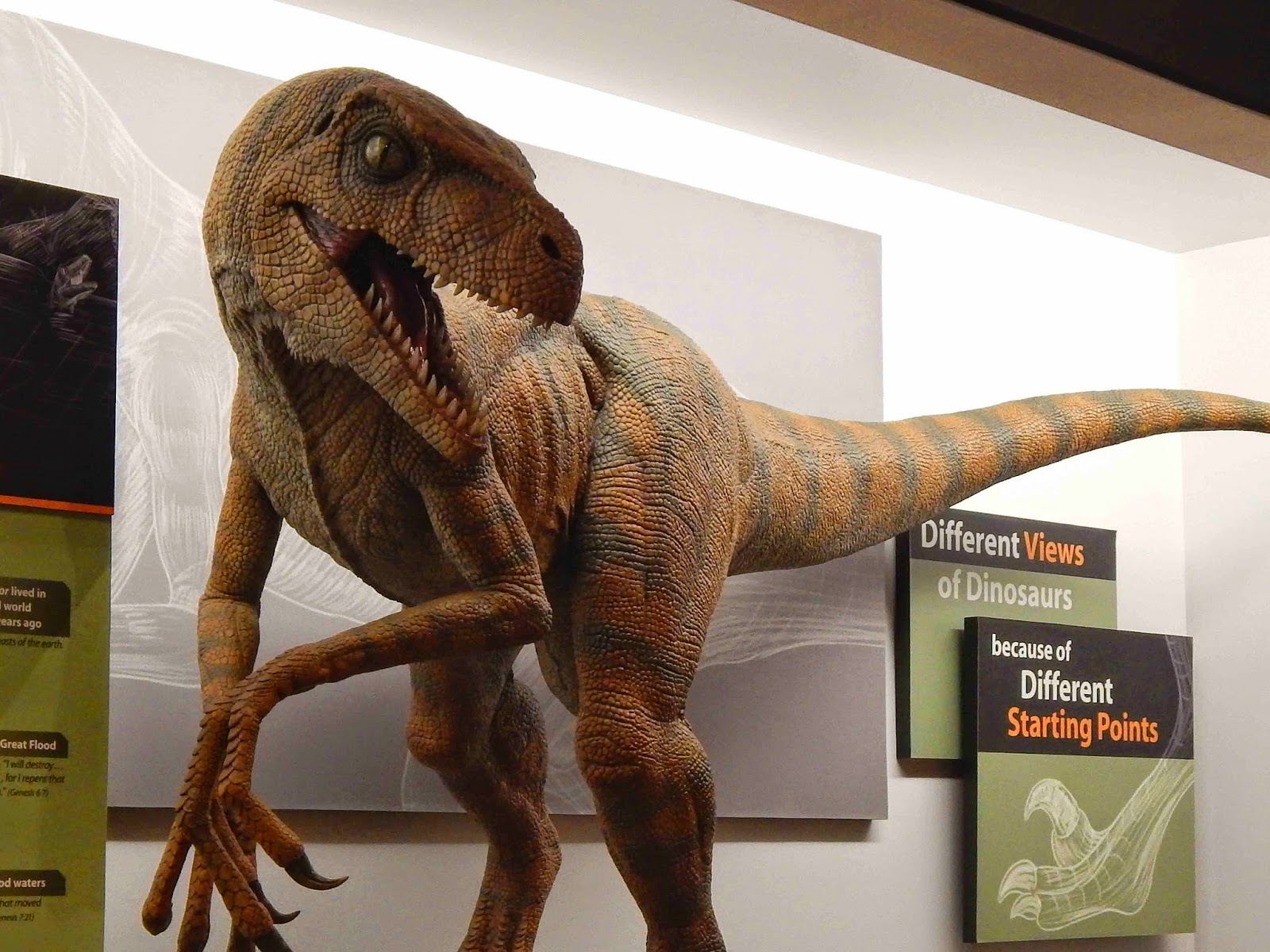
The final stop on my tour of the Creation Museum's displays was an exhibit area known as the Dinosaur Den. This displayed a number of modeled dinosaurs based on fossils that have been discovered around the world.

The dinosaur below looks quite scary, at least when it has its mouth open. All of the specimens in the display seemed remarkably life-like.
Dinosaur

This model shows a skeleton only, which is actually more realistic, because this is all a paleontologist could hope to find at a dig site. Fossil sets this complete are, in fact, very rare. The look of the scales and skin of the other models are primarily determined by the ideas of the sculptor.
Dinosaur Skeleton

Saturday, July 5, 2014

Creation Museum: The Ark 2

Around the U.S.

Following the replica Ark construction site were a number of detailed models representing Ark-related scenes.

The model below shows the animals arriving at the Ark and being stowed inside. The tiny elephants on the ramp show the enormous size of the Ark. The rows of barrels and sacks in the ground are supplies waiting to be brought aboard. This enormous boat did not have to be transported to the water. The water came to it in a deluge on a scale never seen before or since.
Loading the Ark

The Ark came to rest on Mount Ararat 150 days after the Flood began. The model below shows what this might have looked like. While high mountain areas had been exposed, the water continued to recede in torrents and rivers.
Ararat

Monday, June 30, 2014

Creation Museum: The Ark

Around the U.S.

The next display brought to life the historical account of Noah's Ark. This photograph shows what Noah might have looked like as he supervised the construction of his enormous ship.
Noah

To carry every kind of animal, the Ark was an enormous boat. Below we see several workmen assisting in its construction. The exhibit filled a whole room, and yet it only represented one percent of the Ark's actual size.
Under Construction

Saturday, June 28, 2014

Creation Museum: Garden of Eden

Around the U.S.

The next museum highlight was a recreation of a small part of the Garden of Eden. With lively model animals and luscious plastic vegetation, this room almost felt like it was outdoors.

These llamas were one part of the exhibit that stood out. One seems to be craning its neck to observe some distant object, while the other smirks at the viewer.
Llamas

The creature below was one of the more unusual. It looks like a leopard, except for its mottled pattern of scales. Apparently it is an artist's idea of one type of dinosaur, and it is seen here voraciously devouring a pineapple.
Pineapple-Eating Dinosaur

Finally, these two kangaroos could be seen peeking out of the vegetation.
Kangaroos

Thursday, June 26, 2014

Creation Museum: Dinosaur

Around the U.S.

As I mentioned earlier, the Creation Museum exhibits a number of life-sized dinosaurs. While there is an entire room, which we will get to later, dedicated to this purpose, I passed a lone dinosaur specimen early on along the exhibit trail.

This model is a Tyrannosaurus Rex, with sharp, knife-like teeth. It could grow to forty feet long and twenty feet high, with a weight over seven tons. Maybe this model wasn't quite life size, but it definitely was bigger than any T. Rex I'd like to meet!
Tyrannosaurus Rex

Another exhibit displayed ancient scrolls from around the world. The scroll shown below dates from around 1825. Scrolls were often made of vellum produced from animal skins, resulting in a document that could last almost indefinitely. The scroll below contains Hebrew portions of Genesis and Exodus.
Hebrew Scroll 

This exhibit depicts a famous scene of Moses and the Ten Commandments. As you can probably tell from the stone tablets, Hebrew is read from right to left.
Ten Commandments

Sunday, June 15, 2014

Creation Museum: Dinosaur Dig

Around the U.S.

Located in Petersburg, Kentucky, the Creation Museum provides a detailed look at the origin and history of our planet and its inhabitants from a Biblical perspective. Its impressive displays include life-sized dinosaurs, a number of large fossils, and a detailed model of Noah's Ark. Outside, a petting zoo, landscaped garden, and three-acre lake provide additional activities for visitors.
Creation Museum

The first display includes an extremely realistic life-sized fossil excavation, complete with a dinosaur fossil buried in the rock.
Dinosaur Dig

Great care must be taken when unearthing the fossilized bones so they are not damaged. This archaeologist is using a number of tools to extract this dinosaur skeleton.
Archaeologist

Thursday, June 12, 2014

Icy River

Around Ohio

Because of the extremely cold weather, the Scioto River was covered in a layer of ice and snow. The viewing deck shown below provides an excellent view out over the river. The last time I had been here, there were ducks swimming in the water. The sparkling river and chirping birds were nowhere to be seen on this bleak winter day.
Icy Scioto River

All signs of life were gone, except for a few footprints in the fallen snow. Nevertheless, the stillness and placidity of the scene seemed to add to the contrast of dark railings and brilliant snow.
Viewing Deck

Friday, May 23, 2014

Swan and Wolves

Around Ohio

This white swan was one of the few birds that could survive the winter at the zoo. It was sitting near a small pond. Although the pond was mostly covered in ice, it had a small hole at the center where the swan could get a drink.
White Swan

These wolves seemed quite at home in the snow. Their natural habitat in Canada and Alaska can get much colder than our mild winters.
Wolves

Sunday, May 18, 2014

Reindeer

Around Ohio

Another cold-loving animal, and a famous one as well, is the reindeer. They seemed to be enjoying the cold weather just as much as the polar bear. While fourteen distinct subspecies of reindeer have been recognized, I doubt if I could tell them apart. However, their thick fur and large antlers set them apart from other deer species.
Reindeer

Friday, May 16, 2014

Bears

Around Ohio

Every year, the Columbus Zoo creates a luminous display of Christmas lights throughout the zoo. While these are best viewed at night, I planned my recent tour to include enough daylight hours to visit the animals as well. Some of the animals are moved elsewhere during the winter, but many of them remain at the zoo.

The brown bear below didn't seem to mind the cold weather at all. While I watched, it playfully rolled over on its back in the snow.
Brown Bear

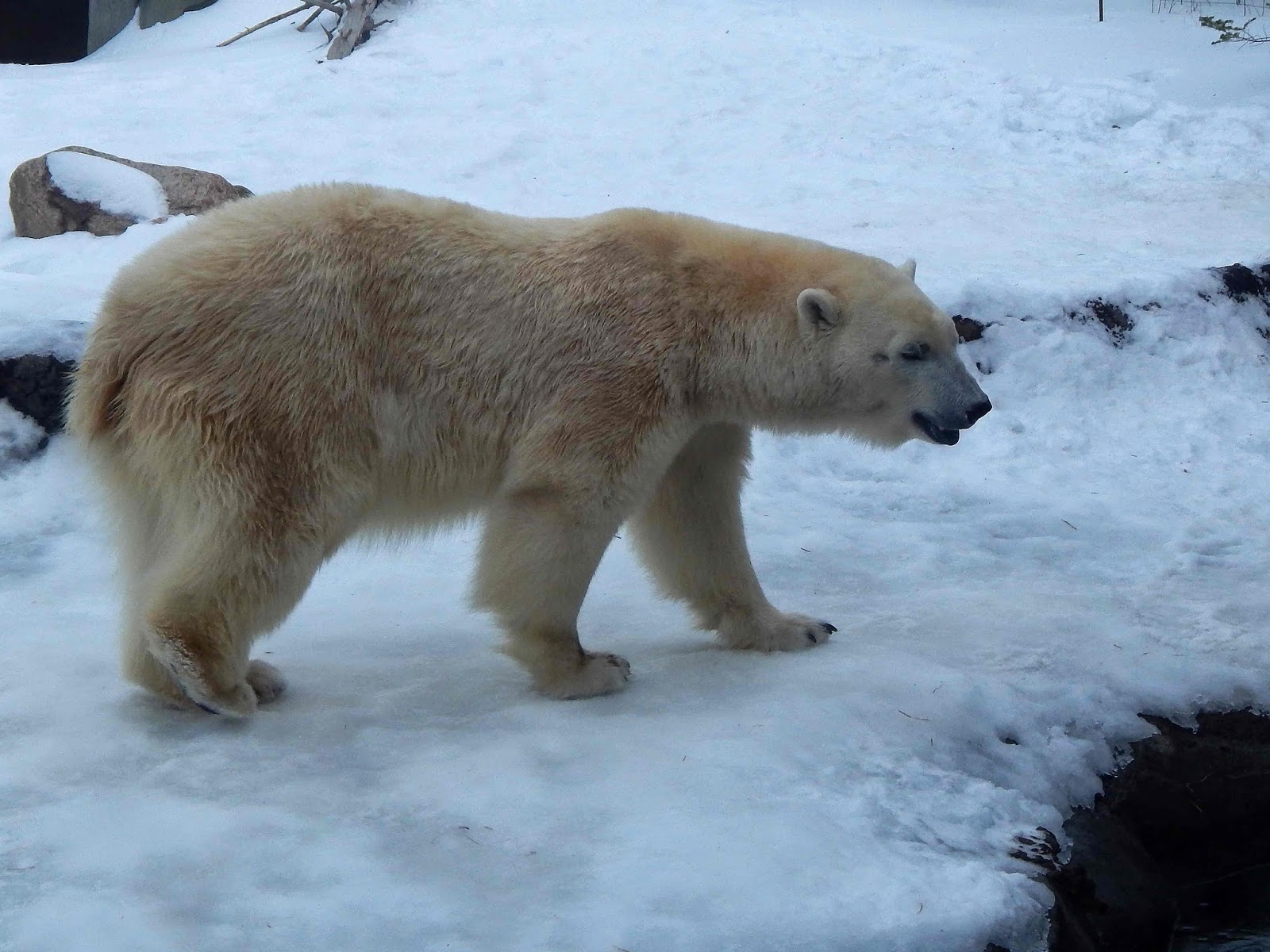
Polar bears, such as the one below, are native to climates even colder than the day I visited the zoo. Their layers of thick fur insulate them from frigid air and ice-cold water. This bear almost looks as if it were grinning.
Polar Bear

Monday, April 21, 2014

Ohio Caverns 2

Around Ohio

The picture below shows one of the iron oxide formations that add color to the ceiling throughout much of the caverns. Although the dim lighting in the caves masks some of the bright colors, they come out quite clearly when exposed to a camera flash.
Iron Oxide Formations

One of the more unusual formations in the cave is shown below. It is called a helictite because of its unusual shape. It seems to resemble a water spigot or old hand pump.
Water Spigot

Monday, April 14, 2014

Ohio Caverns: Crystal King

Around Ohio

The Crystal King is the largest stalactite found in the Ohio Caverns. With a length of almost five feet and an estimated weight of 400 pounds, it is also one of the largest stalactites in Ohio. The Crystal King is found at the deepest point in the cave from the surface.
Crystal King

The stalactites and stalagmites in the photo below reminded me of a shark's mouth. The minerals in this picture are known as dual formations because they consist of calcite stalactites growing on an iron oxide base.
Shark's Mouth

Thursday, April 3, 2014

Ohio Caverns

Around Ohio

Located in western Ohio, the Ohio Caverns showcases some amazing crystal formations spread throughout a maze of winding tunnels. The abundance of crystals, which have taken thousands of years to form, makes the caverns unique.

As with most underground passages, the majority of the Ohio Cavern's tunnels are quite narrow, but the picture below shows a slightly larger area. The oranges and browns on the ceiling are caused by aqueous iron that trickles down through the rock above and oxidizes when it reaches the cave ceiling.
Crystal Cave 

This next shot depicts a more tunnel-like part of the caverns. When the caves were first discovered, most of the tunnels were partially obstructed by mud and other sediment, which had to be cleared away to make the passageways passable.
Rocky Passage